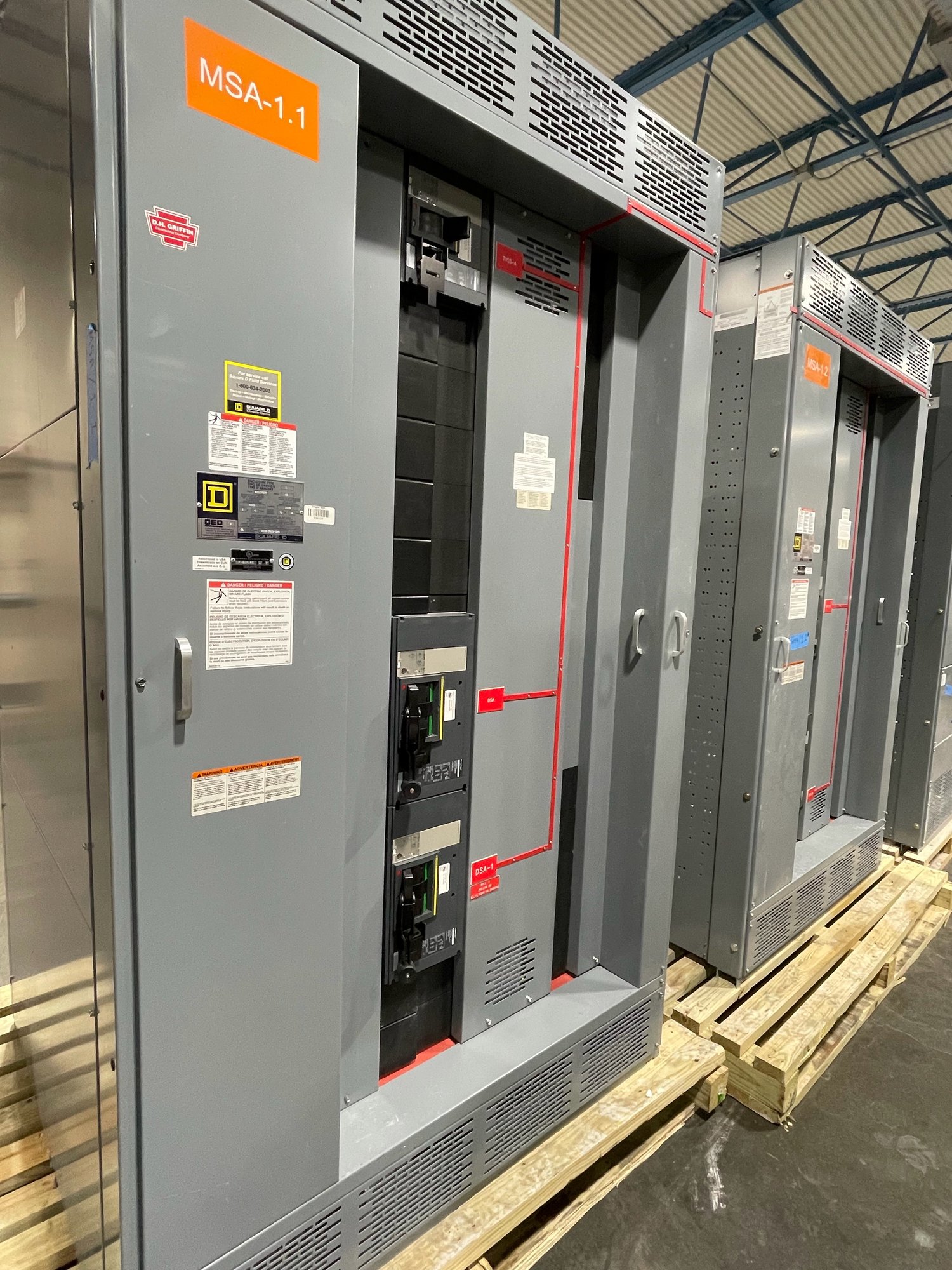
Set the acceptance boundary before testing
Site acceptance testing verifies that installed equipment is in an acceptable condition for the next project step; it is not a substitute for factory testing, installation workmanship review, or commissioning decisions. Define which switchboard sections, breakers, bus connections, control circuits, and interfaces fall within the test. Identify who owns each activity: the installing contractor, testing provider, engineer, facility representative, and equipment manufacturer.
Start with the approved one-line diagram, equipment submittals, drawings, sequence of operation, and project specifications. Resolve differences between those documents and the installed configuration before choosing tests. Record the equipment identification, section lineup, and circuit designations in the plan so test results can be traced to the actual assembly rather than a generic equipment description.
Plan inspection around installation conditions
A visual and mechanical inspection should address shipping damage, enclosure condition, anchorage, alignment, barriers, labels, grounding and bonding, and access to operating components. Check that equipment is clean and dry and that ventilation openings are unobstructed. Compare installed devices and connections with the approved drawings, noting field changes for engineering review instead of assuming they are acceptable.
Confirm that conductors, terminations, cable supports, and external control wiring are complete and identified before tests begin. The inspection plan should state how covers or barriers will be removed and restored, who controls the work area, and how equipment will be kept isolated. Only qualified electrical personnel working under the project’s safety procedures should inspect or test electrical equipment.
Define tests by equipment and risk
Choose test methods and acceptance criteria from the project specifications, equipment documentation, applicable standards, and responsible engineer’s direction. Depending on the design and scope, checks may include insulation resistance, continuity of grounding paths, breaker operation, control-circuit function, interlocks, metering, and protective-device settings or secondary injection. Not every test applies to every assembly, and testing should not exceed equipment manufacturer limits.
Clarify whether primary injection, power-frequency withstand, or other more intrusive procedures are required, and who approves them. Some tests can stress insulation or require disconnecting sensitive devices; identify these constraints in advance. For a UL 891 switchboard, that standard applies to the switchboard assembly, not to medium- or high-voltage switchgear generally. The project team must establish the relevant scope and criteria for each equipment type.
Coordinate outages, access, and responsibilities
Field testing may require an outage, switching sequence, temporary power, restricted access, or coordination with upstream and downstream systems. Agree on the outage window and prerequisites with the facility operator, utility or other system owner when applicable, and construction team. Include weather exposure, site access, lifting or staging needs, and adjacent energized equipment in the work plan, especially where a Georgia project has limited shutdown opportunities.
Assign responsibility for lockout and isolation, test instruments, device settings, temporary connections, and restoration checks. Establish who authorizes each hold point and who can approve a deviation from the plan. If the schedule changes or a test fails, define how the equipment will remain out of service, how the issue will be escalated, and what evidence is required before retesting.
Build records that support handoff
Require a report that identifies the site, equipment, manufacturer, model or catalog identifiers where available, serial numbers, lineup sections, test dates, personnel, instruments, and calibration status. For each test, capture the method, conditions, measured result, acceptance criterion, and pass, fail, or not-applicable disposition. Attach marked-up drawings, settings records, photographs, and a list of open items when they help explain the result.
Separate completed acceptance checks from unresolved deficiencies. Record corrective work, responsible party, retest results, and any approved limitations; do not treat an undocumented adjustment as a closed issue. The handoff package should tell the facility team what was tested, what remains outstanding, and which final documents or approvals are needed before the project proceeds to energization or operational turnover.
Align equipment supply with the field plan
Acceptance planning is easier when procurement documents preserve the information the field team will need. For a new custom-built switchboard, identify the intended test access, device schedules, control interfaces, drawing revision process, and documentation deliverables while the configuration is being developed. Confirm the exact assembly scope, component availability, and production schedule for the order; these details vary by configuration and are confirmed for each project.
When requesting a quote, share the one-line diagram, voltage and current requirements, fault-current information, enclosure and environmental conditions, device and control requirements, applicable specifications, desired delivery location in Georgia, and target project milestones. Also state whether the project has defined field tests or report formats. Coordinate Georgia delivery with site access, unloading arrangements, and the planned acceptance window, then ask for the equipment drawings and records needed to finalize the test plan.