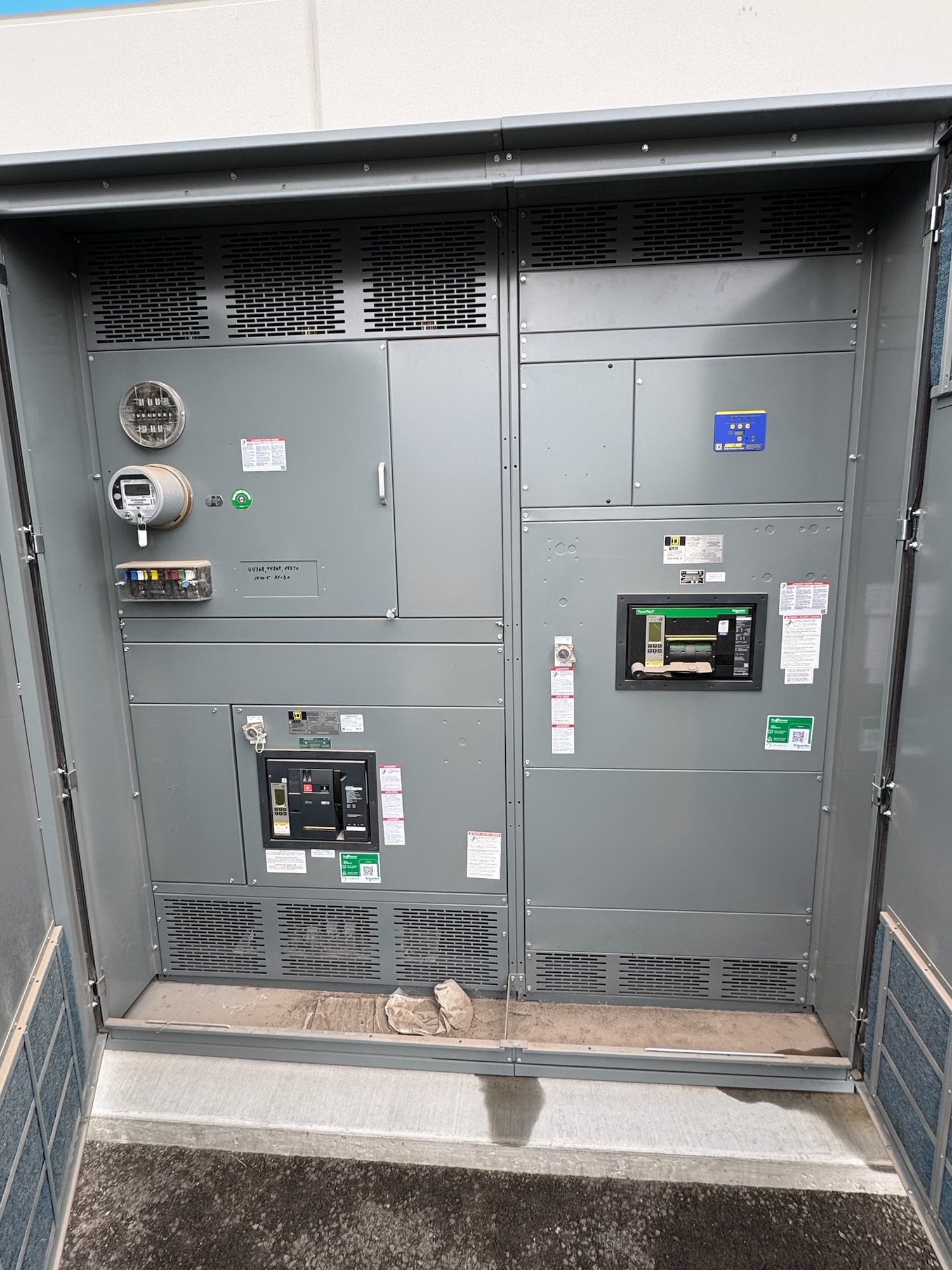
Drawings connect design intent to the installation
A fabrication drawing set shows how the specified assembly is arranged and how it relates to the available space and connected equipment. Depending on scope, drawings may identify overall dimensions, section and compartment layout, door and access orientation, mounting provisions, cable entry areas, bus arrangement and connection points. These details let the project team check whether the proposed configuration fits the intended electrical room and installation plan.
Dimensioning matters most where a small difference affects field work: room clearances, conduit or cable approach, slab or channel interfaces, adjacent equipment, and access for installation and maintenance. Share the latest room layout, equipment schedule, one-line diagram, utility or system requirements, and known interface dimensions when requesting a quote. The manufacturer can then identify information needed to develop the proposed package without assuming an unprovided site condition.
Agree on the drawing package and its limits
Before detailed drawings are prepared, establish which documents are included and what each must communicate. A project may need general arrangement views, elevations, connection or elementary diagrams, terminal information, nameplate schedules, or other details defined by the specification. Not every project needs the same set. Agreeing on deliverables helps engineering, construction and procurement review the right information rather than treating a preliminary layout as a complete fabrication release.
Clarify what is supplied by the switchgear manufacturer and what remains with the engineer, contractor or other equipment suppliers. Confirm the required electrical data, control interfaces, incoming and outgoing connections, accessory scope, and any coordination boundaries. For UL 891 switchboard assemblies, the applicable assembly requirements are addressed within that switchboard scope; UL 891 should not be treated as a blanket listing for medium- or high-voltage switchgear. Final design and approval remain subject to the project’s engineering and authority review.
Use the bill of materials to coordinate scope
A bill of materials links the drawing configuration to the components and assemblies required to build it. It can help purchasing compare the quoted scope with the specification, identify included accessories, and coordinate items that affect enclosure arrangement, control wiring or external connections. A clear bill also makes exclusions and owner-furnished items easier to spot before they become schedule or installation questions.
Review the material descriptions alongside the drawings, not in isolation. Check that quantities and device functions correspond to the intended lineup, and resolve substitutions or specification conflicts through documented approval. American-made components may be incorporated where specified and available for the project, but origin, exact scope and availability should be confirmed for each order. Do not treat a preliminary bill as a promise of final component selection until the applicable technical review is complete.
Control revisions from review through release
Revision control gives every reviewer a shared reference. Each issued drawing should carry an identifiable revision and status, such as preliminary review, approval review or released for fabrication, as applicable to the agreed workflow. A revision record should make changed information traceable so teams can distinguish a corrected dimension from a revised device, connection or scope decision. This reduces the chance that procurement, field coordination and fabrication rely on different document versions.
Establish how comments will be returned, who consolidates them, and how revised sheets or schedules will be distributed. Mark comments clearly and identify whether each is an approval condition, a request for clarification or an informational note. If a change affects the approved configuration after release, document its technical, material and schedule implications before proceeding. Exact revision procedures and timing are confirmed for each order rather than assumed from a generic project sequence.
Make approvals useful and timely
A practical approval workflow names the reviewers and defines what each is checking. Engineering may verify electrical and interface requirements; the contractor may confirm field dimensions and cable approach; facilities staff may review access and maintainability; and purchasing may reconcile the documented scope with the order. The project should identify who has authority to approve the package and whether approval is required before fabrication, component commitment or another milestone.
Approval does not transfer responsibility for the complete system design or field conditions to the manufacturer. Reviewers should resolve exceptions, missing data and conflicts with the project specification in writing. Where an authority having jurisdiction or other project approval is required, the responsible project team should coordinate it. The released package should reflect accepted comments and open items, with any unresolved conditions clearly recorded.
Prepare the handoff for Georgia delivery
For a Georgia project, drawing coordination can support delivery planning without assuming a local office, installation service or fixed transit schedule. Confirm the delivery destination, receiving hours, site access, unloading responsibility and any sequencing constraints early enough to coordinate the shipment with construction. Exact availability, build timeline and shipping arrangements depend on the approved scope and order and are confirmed for that project.
To request a quote, provide the one-line diagram, specifications, required ratings and configuration, preferred drawing deliverables, room or lineup dimensions, interface details, review contacts, approval milestones and Georgia delivery location. Identify known exceptions and the date the project needs an approved fabrication package. Ask which information is still needed for drawing development, then assign a reviewer to return consolidated comments against the issued revision. This gives the team a specific next step toward a coordinated release.