Start with the facility’s governing requirements
Healthcare electrical requirements depend on facility type, occupancy, services provided, project scope, and the adopted codes and standards. Do not assume that a rule applied to another hospital, clinic, renovation, or jurisdiction applies unchanged. The engineer of record and authority having jurisdiction should establish the applicable editions, amendments, interpretations, and approval path before equipment specifications are finalized.
For Georgia projects, identify the facility location and responsible reviewing authorities, then confirm applicable state and local requirements alongside the project’s healthcare standards. Ask whether the work is new construction, an addition, a renovation, or replacement within an operating facility. Those details can affect branch classification, permitted interruptions, review documents, and the sequence for submittal and installation.
Keep essential branches functionally distinct
An essential electrical system is organized around functions, not just a collection of emergency circuits. The required branches may serve different loads and have distinct distribution paths, transfer arrangements, and operational priorities. The project documents should show how each branch is supplied and separated, where transfer equipment is located, and which loads connect at each downstream panel or distribution point.
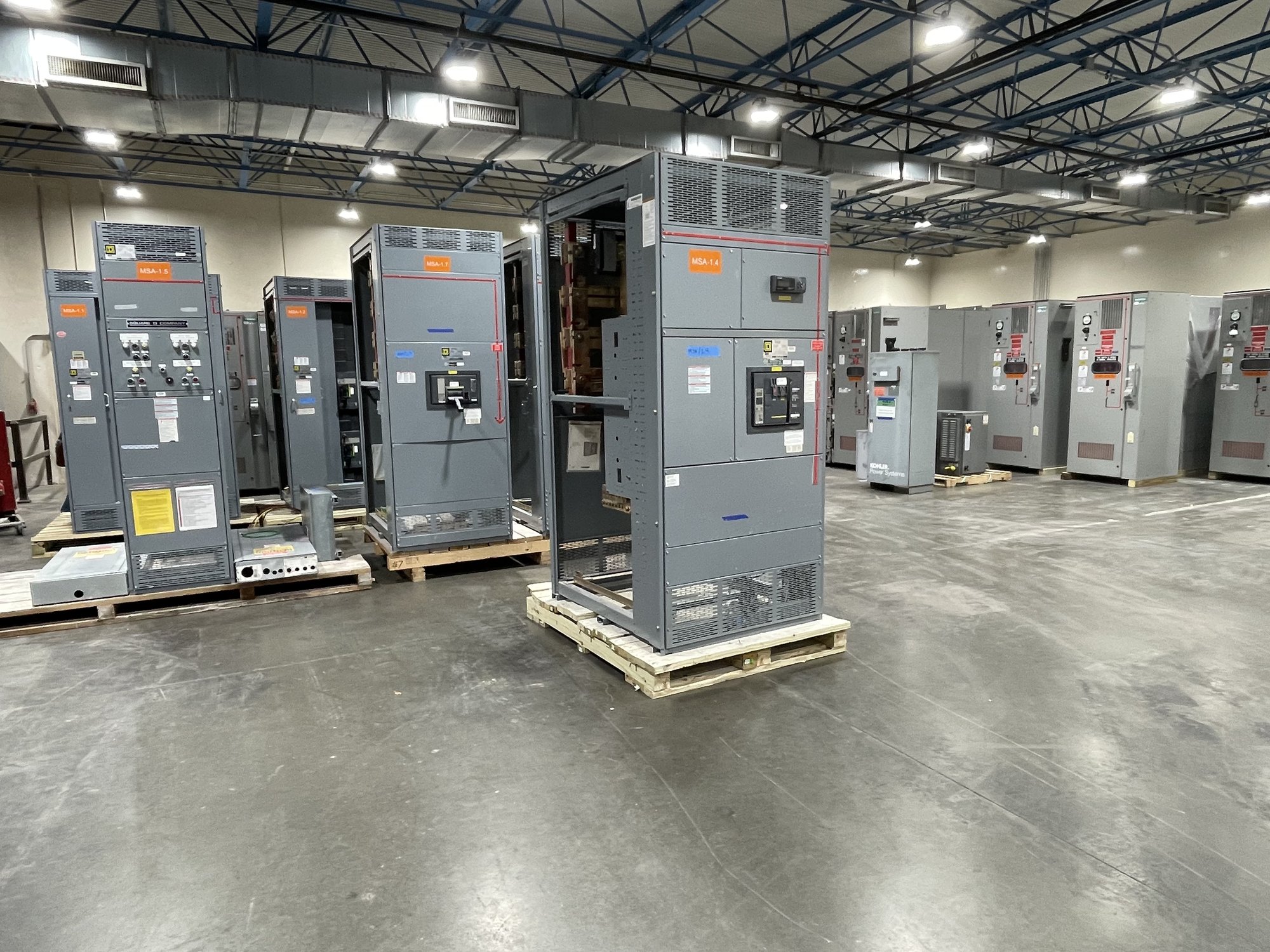
Switchboard layouts should preserve the separation shown by the approved design. Confirm whether the assembly serves one branch or multiple branch sections, how barriers or compartments are specified, and how feeders, metering, protective devices, and spare provisions are assigned. A manufacturer can build to a documented arrangement, but cannot determine clinical priorities or resolve branch classification without direction from the project’s qualified design team.
Coordinate sources, transfers, and load schedules
Before requesting a switchboard quote, provide the current one-line diagram, branch-specific load schedules, source information, and the required relationship to transfer equipment. Clarify whether transfer switches are included in the manufacturer’s scope or supplied separately, and identify interface points, feeder routing assumptions, and any required separation between normal and essential distribution. These details help avoid gaps between switchboard, generator, and transfer-equipment packages.
Load schedules should distinguish connected loads from calculated demand and identify any future loads or reserved spaces. Confirm system voltage, phase, bus and protective-device requirements, available fault-current information, service conditions, metering, and enclosure needs through the engineer’s documents. Do not infer ratings from a prior facility or a preliminary load list; the design team must establish and approve the applicable values.
Resolve space and operating constraints early
Hospitals often have limited electrical-room space and strict construction sequencing. Share room dimensions, access routes, door and ceiling clearances, equipment lineup limits, cable-entry preferences, and the planned placement of adjacent gear. For renovations, identify what must remain energized, what outages are allowed, and when field verification can occur. These constraints can influence section arrangement and shipping configuration, but do not replace an engineered installation and outage plan.
Also identify environmental conditions and operational needs that affect the specification, such as equipment location, maintenance access, labeling conventions, and the facility’s preferred circuit identification. If the assembly must match an existing distribution scheme, provide verified drawings and field data rather than relying on assumptions. The installing contractor and facility team should coordinate handling, placement, terminations, inspection, and energization with qualified personnel.
Define the switchboard scope and review path
UL 891 applies to switchboard assemblies; it is not a blanket listing for medium- or high-voltage switchgear. State whether the requested equipment is a low-voltage switchboard and identify the specified construction and review requirements. Confirm what documentation is needed for submittal, including drawings, device schedules, nameplate information, and coordination with upstream and downstream equipment. Exact assembly scope and availability are confirmed for each order.
A useful procurement package also names who approves deviations, who owns coordination studies, and which project documents control if drawings conflict. Specify required hold points for drawing review and release to production, plus the parties responsible for site measurements and final installation details. Clear responsibility boundaries reduce late changes and help contractors align the equipment package with the broader essential-system design.
Prepare a project-ready quote request
For a quote, share the facility type and Georgia project location, project phase, requested delivery window, approved one-line diagram, branch and load schedules, equipment ratings, scope boundaries, room and access constraints, and submittal requirements. Note whether the request includes related distribution sections or only the switchboard assembly, and identify known interfaces with generators, transfer switches, and existing gear. We build new equipment in the United States and ship nationwide; delivery planning is coordinated to the specific order and site requirements.
Before procurement release, have the engineer of record and relevant authorities confirm the healthcare rules, branch functions, ratings, and design basis for the facility. Then submit the approved documents and clearly marked open items for review. This gives the manufacturer a defined basis to configure the assembly, helps the contractor plan Georgia delivery and installation, and keeps essential-branch separation tied to the facility’s verified requirements.