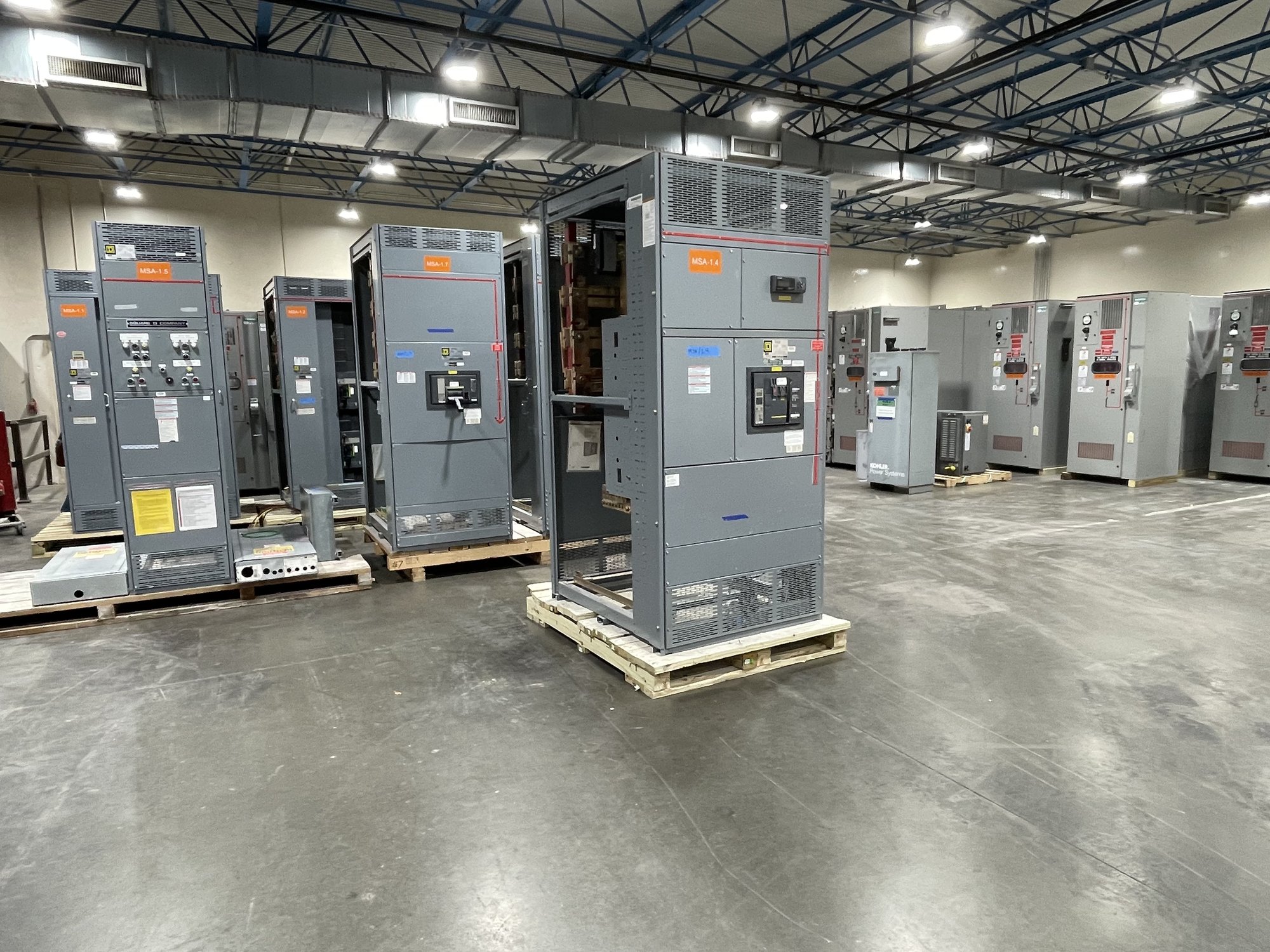
Start with the facility’s essential-load plan
Before equipment is specified, identify which loads the project serves and how the facility classifies them. Patient-care areas, life-safety systems, critical operations, imaging equipment, laboratory functions, and building services may have different continuity needs. The facility’s electrical engineer should establish the applicable distribution arrangement, transfer strategy, and separation requirements rather than relying on a generic healthcare equipment schedule.
For a Sandy Springs project, share the one-line diagram, load schedules, available fault-current information, and the scope of work. Clarify whether the equipment serves a new building, an addition, or a replacement section in an operating facility. These details help define the required lineup, protective-device provisions, bus arrangement, enclosure, and interfaces without assuming a design that has not been reviewed.
Coordinate replacement around patient care
Replacing switchgear in an occupied healthcare facility is a sequencing problem as much as an equipment purchase. Determine which existing sections must remain energized, what temporary power or alternate feeds the engineer has designed, and which outage windows the facility can support. Include infection-control procedures, access limitations, noise restrictions, and clinical department schedules in the project plan where they affect work or delivery.
Equipment fabrication and site work follow different schedules. Confirm the required submittal and approval dates, factory completion target, delivery window, receiving arrangements, and planned outage milestones with the project team. Do not treat an estimated equipment date as authorization to de-energize existing gear. The electrical contractor and facility representatives should coordinate switching and installation procedures with qualified personnel under the project’s approved plan.
Define the switchboard or switchgear scope
Specify equipment by function and verified electrical requirements, not by a general label such as hospital switchgear. A UL 891 switchboard assembly may suit a particular low-voltage distribution scope, but UL 891 is a switchboard standard and does not apply as a blanket listing for medium- or high-voltage switchgear. The engineer should identify the equipment type, system voltage, current and interrupting requirements, configuration, and applicable project standards.
Document feeder quantities and sizes, main and tie arrangements, metering, protective devices, control power, communications, and future provisions. State any requirements for drawout construction, barriers, cable entry, neutral treatment, or arc-energy reduction features where the design calls for them. Confirm dimensional limits, working clearances, and routing against the actual electrical room and access path before approving a build.
Resolve interfaces before procurement
Healthcare upgrades often involve existing transformers, generators, automatic transfer equipment, remote annunciation, building controls, and monitoring systems. Identify which devices are new, retained, or supplied by others, and provide interface drawings or schedules when available. Confirm control wiring responsibilities, communication protocols, terminal requirements, and the boundary between switchgear and adjacent equipment so procurement does not leave gaps.
For replacement work, gather existing nameplates, equipment dimensions, cable locations, and photographs where permitted. Record known field conditions and flag information that still needs verification. A site-specific review can expose constraints such as narrow doors, limited staging space, overhead obstructions, or cable lengths that affect the configuration and delivery plan. Engineering and the authority having jurisdiction must review the final design and applicable requirements.
Plan procurement and delivery in Georgia
We manufacture, build, and supply new equipment in the United States, including custom-built configurations and UL 891 switchboard assemblies. American-made components and nationwide shipping support project planning, but component availability, exact scope, and production timing depend on the requested configuration and are confirmed for each order. Request pricing against a defined equipment schedule so the quotation reflects the actual application.
For delivery to Sandy Springs, coordinate the site address, receiving hours, truck access, unloading responsibility, storage conditions, and restrictions on when equipment can enter the building. Confirm whether the facility needs staged shipments or delivery aligned with construction milestones. Georgia delivery planning should include the contractor’s sequence and the facility’s receiving capacity; shipping arrangements and dates are established for the specific order, not assumed.
Prepare a useful quote package and handoff
For a quote, provide the project location, equipment schedule, one-line diagram, required ratings, lineup dimensions, scope boundaries, and target submittal and delivery dates. Add the replacement sequence, outage assumptions, access constraints, and any required interfaces with generators, transfer switches, or controls. Identify open engineering decisions clearly, including who will resolve them and by what procurement milestone.
Before release, align the approved submittals with the project’s installation and commissioning plan. Confirm shipment contents, handling instructions, final connection responsibilities, and required documentation with the project team. Send the Sandy Springs project documents and constraints together for review, then confirm equipment scope, availability, and delivery timing before placing the order. That early coordination gives facility, engineering, and procurement teams a clearer basis for scheduling work around patient care.