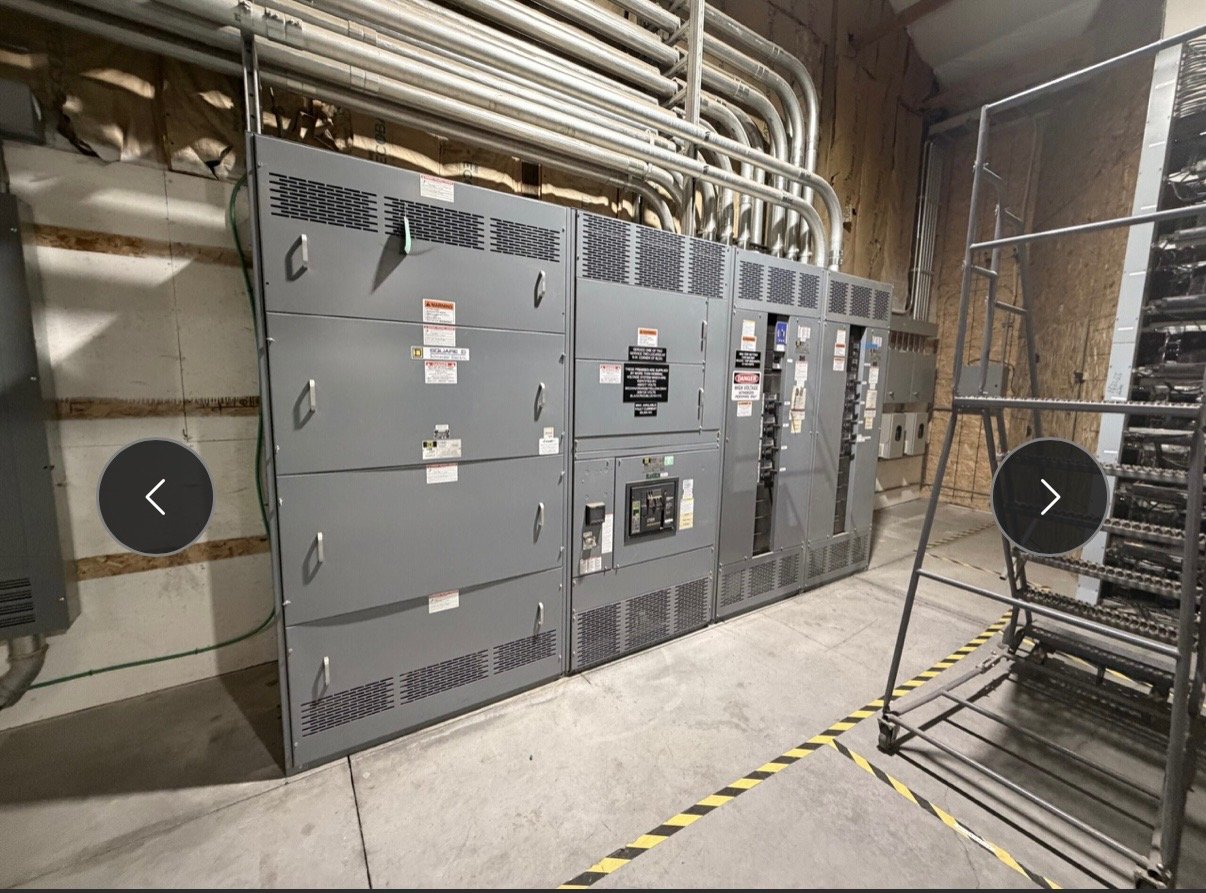
Establish the ownership line
Ownership can change at the service point, transformer, meter, or another location defined by the utility’s service requirements and project agreements. Do not assume a standard arrangement. Obtain the applicable service drawings, written utility requirements, and existing one-line diagram, then mark which party owns each transformer, conductor, enclosure, metering component, protective device, and switchboard section.
The boundary may not align with a convenient physical point or a single enclosure. A utility-owned transformer can supply customer-owned service equipment, while metering or protective components may have separate ownership and access rules. Record the ownership and operating responsibility for each component rather than labeling an entire room or lineup as simply utility or customer equipment.
Translate responsibilities into specifications
For customer-owned switchgear, establish the electrical interface from confirmed project data: service voltage and phase, available fault current, grounding arrangement, conductor entry, and utility-approved service configuration. Ask which side supplies and terminates conductors, what metering provisions are required, and whether the utility specifies barriers, compartments, or a particular service entrance arrangement. Treat these as project questions until the serving utility confirms its requirements.
Define the intended function and lineup boundaries in the equipment specification. Identify incoming and outgoing sections, feeder quantities, metering provisions, control interfaces, and the space available for installation. If a UL 891 switchboard assembly is under consideration, specify that scope explicitly; UL 891 applies to switchboards, not as a blanket listing for medium- or high-voltage switchgear. Engineering review must resolve the design and applicable requirements for the actual installation.
Set access and maintenance rules
Ownership affects who may enter a space, operate a device, remove covers, or schedule work. Confirm utility access procedures, required clearances, locks or restricted compartments, and any limits on customer operation. Coordinate room layout and equipment placement around those rules, including the route for conductors and the working space required by the final design. Do not assume that customer staff can operate utility-owned devices or that utility personnel maintain customer equipment.
Write down maintenance responsibility for each asset, including inspection, cleaning, testing, repair, and outage coordination. Where equipment shares a room or enclosure, distinguish the physical access path from authority to perform work. The owner and qualified personnel responsible for operation should establish procedures before turnover; facility staff should not be left to infer responsibility from labels or appearance.
Coordinate engineering and procurement
Bring the utility’s service requirements into design review before releasing equipment for manufacture. Compare the utility-approved one-line diagram with the switchgear or switchboard submittal, checking the service point, metering arrangement, protective-device interfaces, conductor terminations, and ownership demarcations. Resolve discrepancies in writing with the responsible engineers and utility representatives. A late change to incoming configuration or compartment access can affect the lineup and project schedule.
For a manufacturer quote, share the one-line diagram, utility service documents, equipment scope, electrical ratings established by the project engineer, enclosure and environmental requirements, cable entry details, metering requirements, and delivery destination. Identify which components are utility-furnished or utility-owned and which are in the new equipment order. Custom configurations, component availability, and production timing are confirmed for each order; do not assume a standard lineup fits the utility’s requirements.
Plan delivery, installation, and handoff
In Georgia, align equipment delivery with the site’s construction sequence, receiving access, rigging plan, and utility inspection or connection milestones. Nationwide shipping can support Georgia projects, but the delivery destination, schedule, and handling plan must be confirmed for the specific order. Verify that the route into the electrical room and the available space match the equipment configuration before shipment, and coordinate any utility-controlled access separately.
Before energization, the project team should reconcile final drawings and labels with the agreed ownership boundary. Provide the facility owner with the final one-line diagram, equipment documentation, operating instructions, and a clear record of who maintains and controls each section. Assign responsibility for utility coordination, installation, testing, and approval to qualified parties and the applicable authorities; purchase documentation does not replace their review.
Close boundary questions before release
A practical pre-order review should answer: Where is the service point? Which party owns each device and conductor? Who provides, terminates, operates, and maintains each component? What utility-approved metering and protection arrangement applies? What equipment belongs in the manufacturer’s scope, and what access restrictions affect the layout? Record the answers on the project one-line or scope documents and circulate them to engineering, procurement, contractor, facility, and utility stakeholders.
For a Georgia project, submit those documents with the required equipment configuration and delivery destination when requesting a quote. Ask the utility to confirm unresolved service conditions before the design is finalized, then confirm the ordered scope and schedule against the approved interface. This makes the ownership boundary a documented design input and gives each party a specific handoff rather than an assumption.