Map the airport’s operating loads
Start with a load schedule that distinguishes terminal functions from airfield and campus support. Passenger areas, check-in systems, baggage conveyors, security equipment, tenant spaces, maintenance facilities and site utilities may have different demand patterns and operating priorities. Identify normal, standby and future loads, and note which equipment must remain available during planned work or a source transfer.
Airport loads can change as terminals are renovated, gates are added or tenant layouts shift. Share demand calculations, available service information, major motor loads, anticipated expansion and any known constraints on electrical-room space. The project engineer can use this information to establish the required distribution arrangement and confirm the equipment scope; the manufacturer can then build to the approved documents.
Separate critical circuits with intent
Continuity planning depends on more than assigning a label such as critical. Identify the specific circuits that support life safety, security, airfield operations, flight information, communications, baggage movement, refrigeration or other airport functions. Clarify which loads are backed by emergency or standby sources and which may be shed, delayed or restored in stages. These decisions affect feeder organization, protective-device coordination and operating procedures.
Provide one-line diagrams and control narratives showing normal and alternate sources, transfer equipment, interlocks, metering and any required load sequencing. Confirm the intended boundaries between switchboards, emergency distribution and other equipment with the engineer of record and applicable authorities. UL 891 applies to switchboard assemblies; it should not be treated as a blanket listing for medium- or high-voltage switchgear.
Resolve equipment and room constraints
Airport electrical rooms may be located in active terminals, service corridors, basements or remote support buildings. For each installation, confirm room dimensions, access routes, door and elevator limits, floor loading, working clearances and the space needed to handle sections during placement. Check the approved layout against adjacent piping, fire protection, cable entry paths and existing equipment before releasing a build.
Specify system voltage, available fault-current information, bus configuration, main and feeder arrangements, device types, ratings, metering, communications and enclosure requirements. Identify environmental conditions such as moisture, dust or temperature exposure, as well as any arc-flash study or coordination requirements that govern device selection. Engineering review must establish applicable ratings and installation requirements for the actual site.
Coordinate work in an operating airport
Construction phasing is a core design and procurement issue when passenger service or airfield activity continues around the work. Define outage windows, temporary power responsibilities, cutover sequence, equipment boundaries and the parties responsible for testing and commissioning. Existing-system information should include verified feeder destinations, source arrangements and available fault-current data, rather than assumptions based on incomplete labels.
For phased projects, ask whether the proposed lineup can accommodate planned additions or staged installation without compromising the approved design. Establish how equipment sections will be identified, what drawings and settings information are required at handoff, and how changes will be reviewed. Switching, installation, testing and energization belong with qualified personnel under the project’s approved procedures.
Prepare a complete purchase package
For a useful quotation, share the project location in Georgia, required equipment type, system voltage, one-line diagram, load and feeder schedules, fault-current data, device and bus requirements, enclosure conditions, communications needs and requested submittal documents. Include the project phase, required delivery window, receiving constraints and whether the package must align with existing equipment or a larger construction sequence.
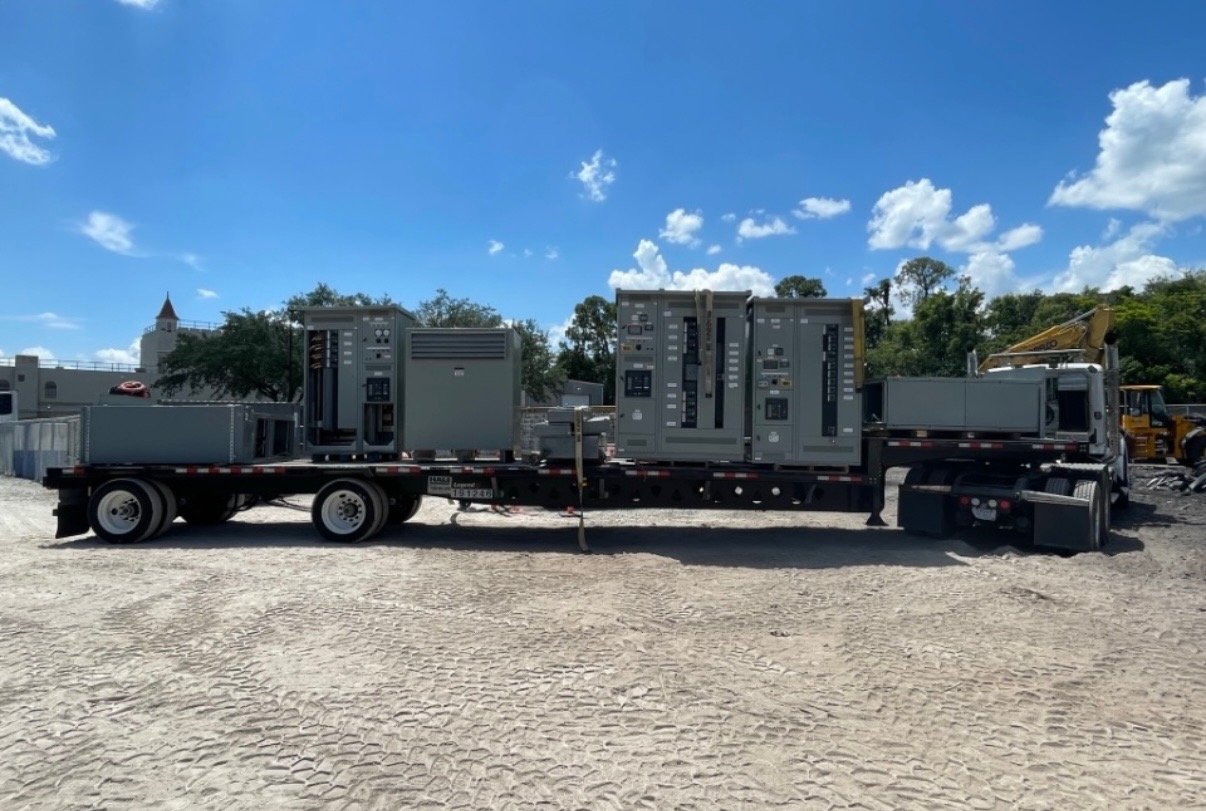
We manufacture and supply new equipment in the United States, with American-made components and custom-built configurations available to project requirements. Exact scope, component availability and schedule are confirmed for each order. Nationwide shipping can be coordinated to a Georgia airport project, but the purchaser should provide delivery access, receiving hours, unloading arrangements and any restrictions on truck routing or staged receipt.
Carry decisions through handoff
Before approval, compare the quotation and submittals against the engineer’s one-line, schedules, specifications and room layout. Resolve exceptions in writing, including device substitutions, short-circuit ratings, metering, control interfaces, cable entry and future provisions. Confirm who reviews drawings, approves deviations and releases the equipment for manufacture so procurement does not proceed on an outdated design.
For the next step, assemble the current one-line diagram, feeder schedule, project specification, site delivery requirements and target construction milestones. Identify which airport loads require continuity, the source and transfer arrangement, and any planned terminal or airfield expansion. This gives the project team a clear basis to confirm a tailored equipment scope, submittal path and delivery plan for the Georgia installation.