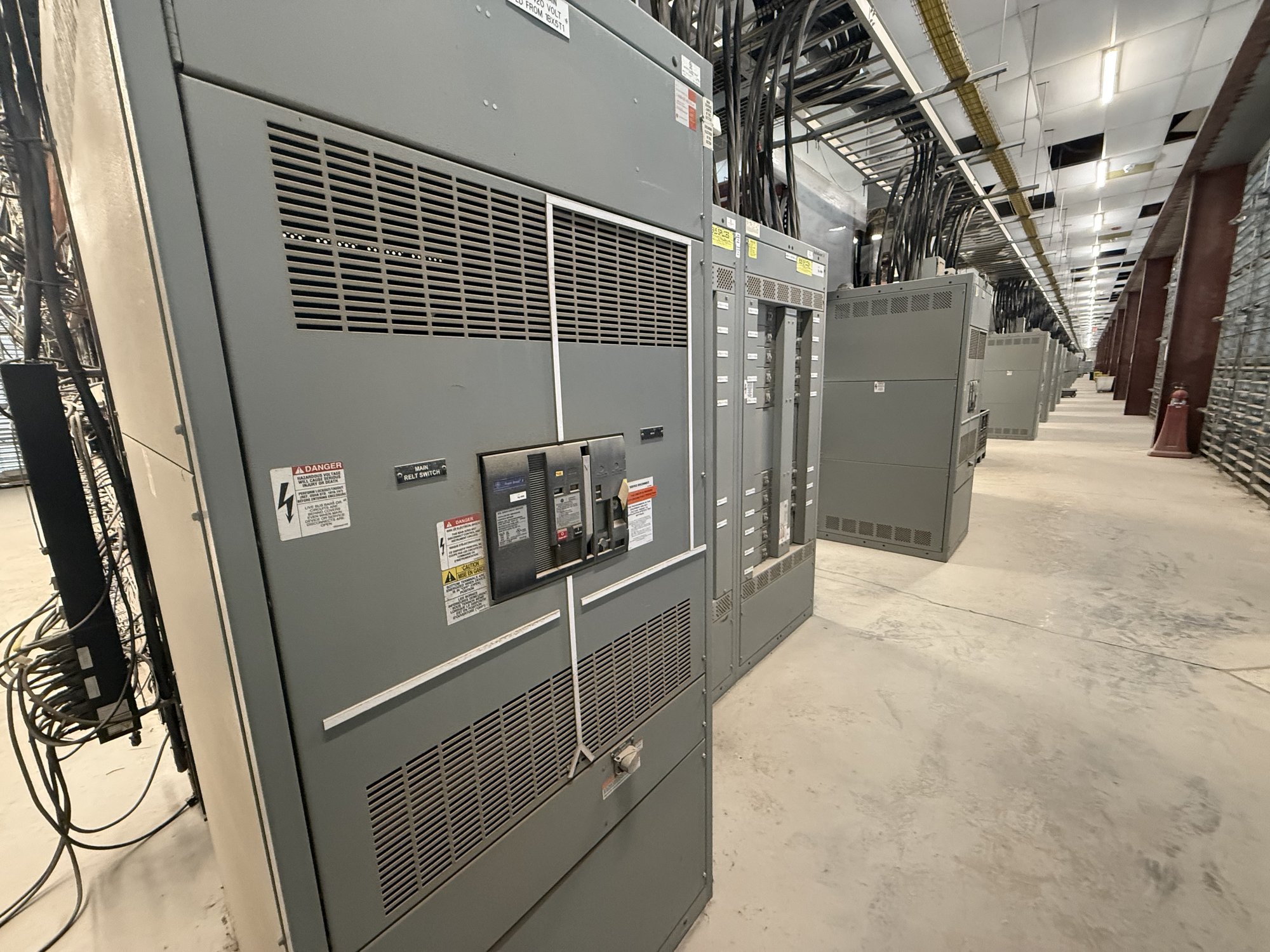
Start with the transformer secondary
Provide the transformer’s rated kVA, primary and secondary voltages, phase, frequency, impedance and connection details. Confirm whether the switchboard will connect directly to the secondary terminals or through secondary conductors, and share conductor length, material, quantity per phase and installation arrangement when known. These details inform available fault current and the practical requirements for the service entrance or feeder section.
Do not treat transformer kVA as a complete switchgear specification. The secondary full-load current can be calculated from kVA and voltage, but that result alone does not establish the required main device, bus rating or interrupting capability. Transformer impedance, upstream protection, conductor characteristics and system configuration also affect the evaluation. Have the engineer confirm the applicable design basis and provide it with the equipment request.
Coordinate secondary protection
Identify the intended secondary main protection arrangement: a breaker, fused switch, or another engineered configuration. Share the proposed device rating and type, protective-device information on the transformer primary, and any known coordination requirements with downstream feeders. The design team can then evaluate how the switchboard configuration should accommodate the specified protection and how the available fault current relates to device interrupting ratings.
Protection requirements depend on the complete electrical system and governing project conditions. An equipment quote should not substitute for a short-circuit study, selective-coordination analysis, or review by the responsible electrical engineer. If those studies are pending, state that clearly and identify which values remain preliminary. Final equipment selections and ratings require engineering review and approval by the authority having jurisdiction where applicable.
Size bus for demand and growth
Select bus capacity from the project’s calculated demand and operating conditions, not from the transformer nameplate alone. Provide the load calculation or demand estimate, connected load schedule, major motor or process loads, continuous-load assumptions, and expected operating patterns. Note planned additions such as production equipment, building expansions, electric vehicle charging or larger HVAC loads, and distinguish committed loads from longer-term possibilities.
A larger transformer does not automatically require a switchboard bus at the transformer’s full output, and a lower projected demand does not by itself justify a smaller bus. The engineer must reconcile load, protection, applicable requirements, future plans and the intended system arrangement. For procurement, identify the requested bus rating and any anticipated spare feeder spaces separately; physical spare spaces do not establish spare electrical capacity.
Resolve the design inputs before release
Before requesting a configuration, assemble the one-line diagram, transformer data sheet, available fault-current information, load schedule, feeder count and proposed protective-device details. Include enclosure and installation requirements, cable entry direction, termination preferences, metering or control needs, and any project-specific sequence of operation. Mark each item as final, estimated or still under engineering review so assumptions are visible rather than embedded in a purchase order.
Ask the manufacturer to confirm the proposed assembly scope, device and bus details, interface points, and the information still needed to finalize the build. For a UL 891 switchboard assembly, identify that requirement explicitly; UL 891 applies to switchboards and does not establish a listing for medium- or high-voltage switchgear. Confirm the applicable equipment category and project requirements with the engineer and authority having jurisdiction.
Plan the handoff and Georgia delivery
A useful quote request answers practical questions: What are the transformer kVA, secondary voltage and impedance? What main protection is specified? What fault-current value and study basis are available? What are the calculated present and projected loads? How many feeders are required now, and what growth is planned? Also state the project location in Georgia, site access constraints, receiving hours and the requested delivery window.
Delivery planning should account for the switchboard’s final configuration, shipping dimensions and weight, unloading equipment, route to the electrical room, and any site restrictions. Share those constraints early so the equipment configuration and shipment plan can be reviewed together. Exact scope, availability and timeline are confirmed for each order; Georgia delivery arrangements are coordinated to the project rather than assumed from a general service area.
Make the sizing decision actionable
Before equipment release, have the responsible engineer reconcile transformer output, secondary conductors, main protection, bus capacity, projected demand and fault-current requirements on the same approved design documents. Resolve any differences between the one-line diagram, schedules and quote, and record which values are final. This reduces avoidable changes when the switchboard configuration moves from preliminary review to production.
For a focused manufacturer quote, send the latest one-line diagram, transformer data, load calculation, protection criteria and feeder schedule, plus the Georgia delivery location and site constraints. Flag unresolved engineering assumptions and identify who will approve final ratings. That handoff gives the manufacturer a clear basis to configure new switchgear while leaving design approval and code determinations with the responsible professionals and authorities.