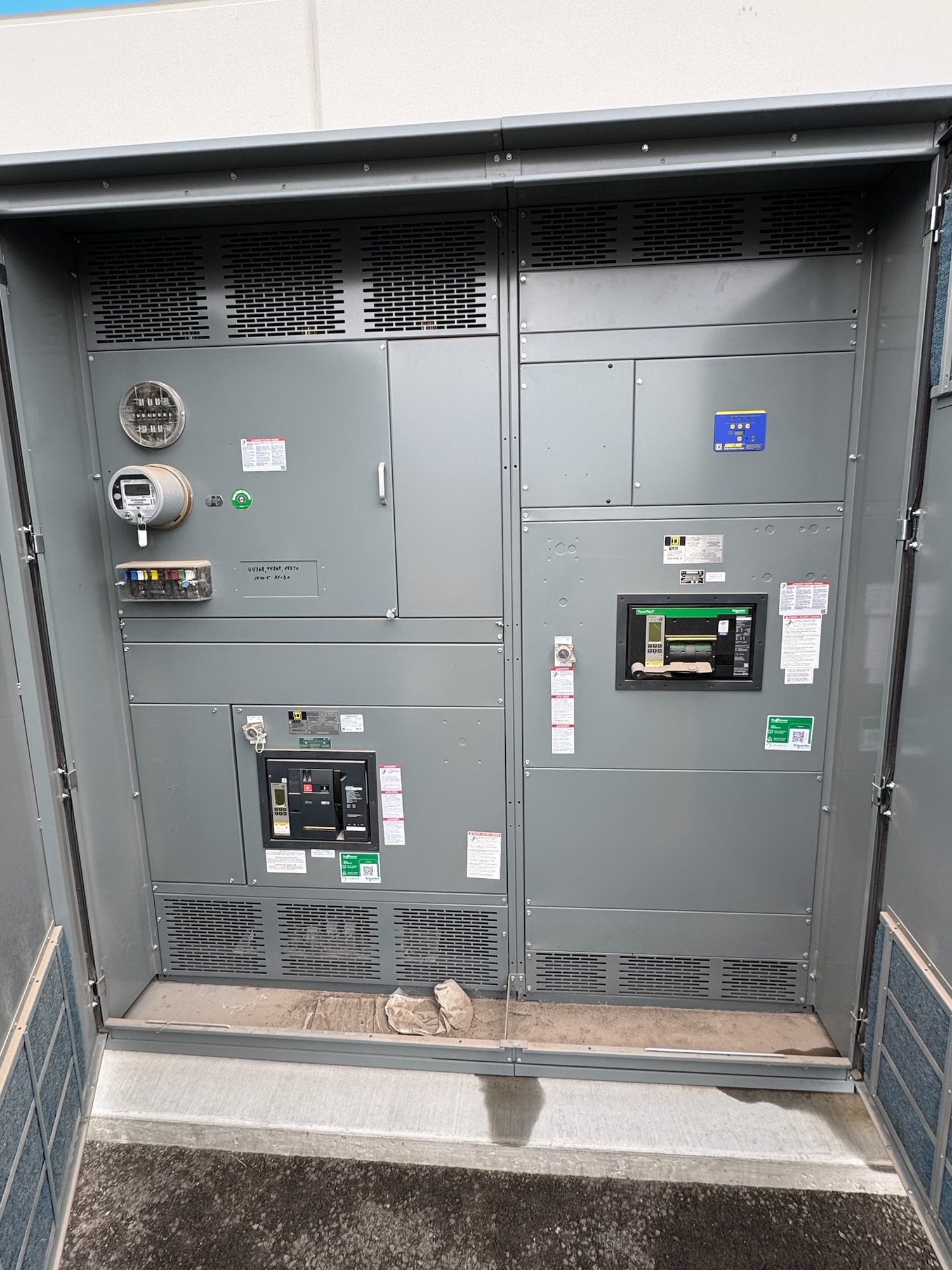
Trace the exposure before choosing a remedy
Start by documenting where corrosion appears and what conditions may be driving it. Coastal salt air, humid spaces, condensation, roof or plumbing leaks, washdown, process chemicals and poor ventilation can affect equipment differently. Note whether deposits are concentrated near doors, louvers, the base, cable entries, bus compartments or adjacent piping. Photographs, dates and operating or building events help establish whether the condition is active or longstanding.
The visible deposit alone does not identify the contaminant or the extent of damage. Ask facilities staff about temperature swings, water intrusion, cleaning products, flood events and changes to HVAC or room use. Record enclosure location, indoor or outdoor exposure, equipment age, manufacturer and model, and any previous repairs. These details help an engineer distinguish a localized enclosure issue from exposure that may have reached electrical components.
Assess electrical integrity through qualified review
Corrosion can reduce contact quality at bolted joints, weaken conductors or hardware, compromise plating, damage insulation and interfere with mechanisms. Rust on an exterior panel is not proof that internal parts are affected, but an apparently clean exterior does not establish that bus, terminals, breakers or control wiring are sound. Assessment should be performed by qualified electrical personnel using procedures appropriate to the equipment and site conditions; do not open, touch or energize suspect gear without proper authorization and controls.
The review should identify affected components and determine which inspections or tests are appropriate for the equipment design and condition. Relevant records may include one-line diagrams, nameplate data, maintenance history, prior test reports, breaker information and photographs from before the exposure. Findings should distinguish observed facts from items that could not be examined, and state whether cleaning, component replacement, further testing or removal from service requires engineering direction and coordination with the authority having jurisdiction.
Compare repair with replacement on evidence
Repair may be considered when damage is limited, the cause can be corrected, and qualified personnel can verify the condition and suitability of retained parts. The scope could include replacing affected hardware or components, restoring enclosure protection, correcting water entry, or improving room conditions. Cleaning alone is not a remedy for damaged plating, weakened metal, compromised insulation or a connection whose integrity cannot be established. Any repair approach needs a defined inspection and acceptance basis.
Replacement becomes more compelling when corrosion is widespread, critical parts are unavailable, damage affects bus or insulation, the enclosure cannot be restored, or documentation and testing cannot support continued use. Compare the full scope: outage planning, demolition and disposal, new equipment configuration, cable interface, controls, testing and commissioning. Do not assume existing dimensions, ratings or protective devices can be carried forward without review. An engineer should validate the design and applicable requirements for the installation.
Specify new equipment around the actual installation
For a replacement quotation, provide the existing switchgear or switchboard nameplate information, one-line diagram, available fault-current data if known, system voltage and phase, main and feeder arrangement, ampere ratings, breaker types, metering and control needs, and enclosure location and environment. Include clear photographs, overall dimensions, cable entry direction, termination details, required accessories and any known site restrictions. Identify which information is confirmed and which needs field verification.
Corrosion-related replacement specifications should also address the environmental cause rather than simply reproduce the old enclosure. Share whether the gear is indoors or outdoors, exposure to salt, chemicals or washdown, ventilation and condensation concerns, and any room or enclosure changes planned. We build new switchgear and UL 891 switchboard assemblies in the United States with American-made components, subject to the specified configuration and availability. UL 891 applies to switchboard assemblies; it does not establish a blanket listing for medium- or high-voltage switchgear.
Plan procurement, delivery and handoff
Purchasing decisions depend on engineering scope, component availability, configuration, approvals and the outage window. Provide the required in-service date, decision milestones, submittal needs, site access limits and delivery constraints when requesting a quote. Exact scope, availability and timeline are confirmed for each order. Short lead times may be possible for some configurations, but they are not guaranteed; custom-built arrangements and specified components can affect the schedule.
For Georgia projects, confirm the delivery address, receiving hours, unloading capability, site access and whether equipment must be staged or coordinated with construction. Nationwide shipping supports projects across the state, but the project team should coordinate transport and on-site handling with the contractor and facility. Before release, reconcile approved drawings, connection details, dimensions, protective-device requirements and delivery sequence. The handoff should identify open field-verification items and who is responsible for installation, testing and energization.
Turn findings into a defensible next step
A useful corrosion assessment ends with a condition record, likely exposure source, affected components, limits of inspection, and a clear recommendation: monitor, correct the environment, repair under an approved scope, or replace. If replacement is under consideration, send the equipment records and site details with the quote request, including photographs of the corrosion, one-line diagram, nameplate data, interface dimensions, environmental conditions and target outage date. This gives engineering and procurement a concrete basis to compare options.
Do not treat uncertain electrical integrity as a purchasing shortcut or assume a new enclosure will solve an unresolved moisture problem. Have qualified personnel determine equipment status and required site controls, then have the design reviewed for the installation and applicable authority requirements. Once scope is established, align the new equipment configuration, submittal review, delivery plan and outage sequence so remediation addresses both the damaged gear and the conditions that caused it.